How to write a website brief that saves you £2,000 (and gets you a better site)
Most Cardiff small-business website projects overrun by 50–100% — not because agencies are dishonest, but because the brief was vague. Two pages, written before you talk to any agency, removes most of the cost overrun before the project starts and routinely saves £1,500–£3,000.
The two hours that save you two grand
Almost every website cost overrun we've seen — and we audit roughly one a week — traces back to one of three things: the goal was never written down, the scope was bigger than the budget, or the launch date was wishful thinking. None of those are technical problems. They're brief problems.
A good brief takes ~2 hours to write, costs you nothing, and routinely saves £1,500–£3,000. It's the single most leveraged piece of work you can do before talking to any agency.
The two-page brief, in order
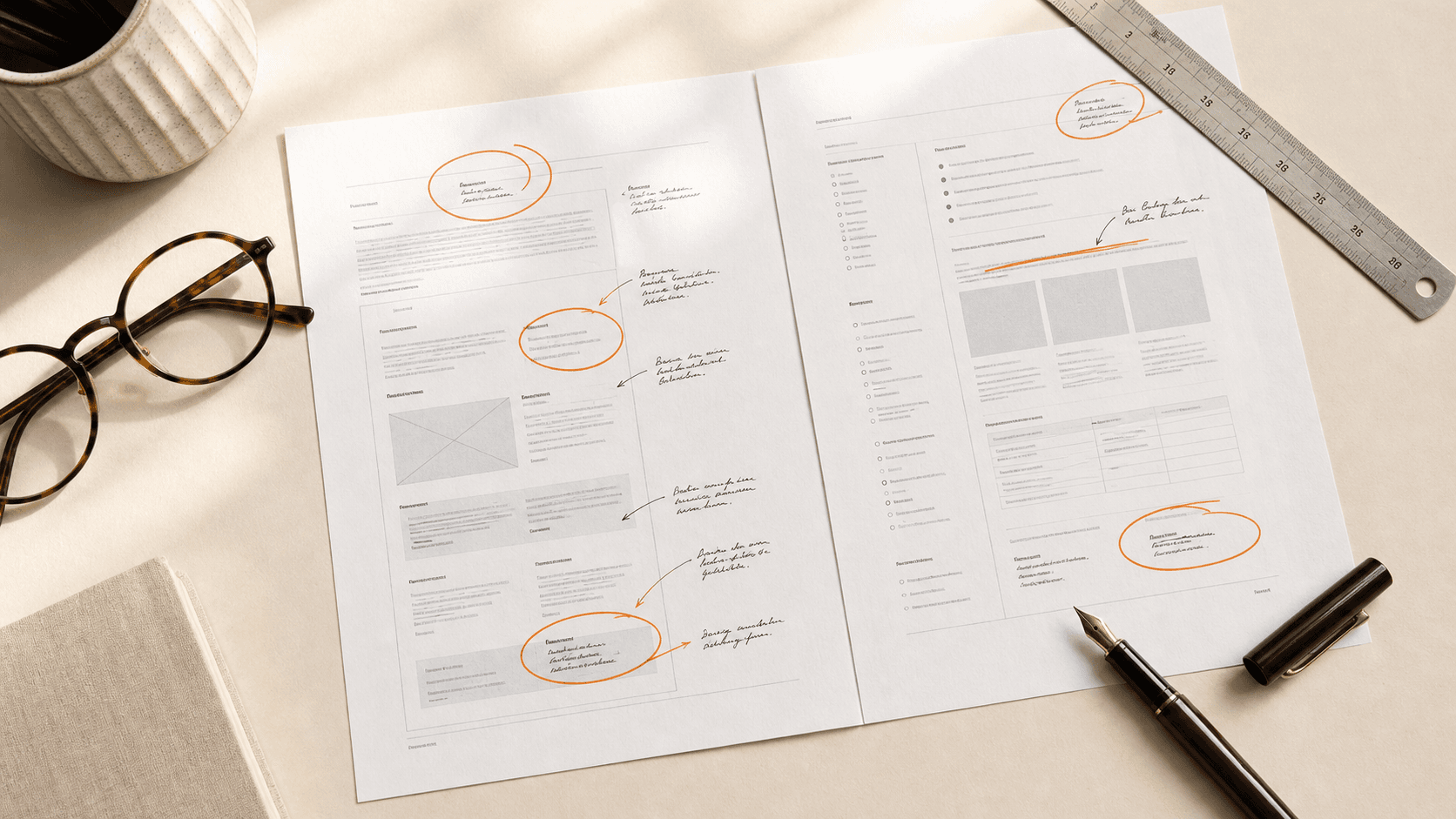
The whole brief fits on two sheets of A4. Anything longer is a project plan, not a brief. Here's the order:
Each block answers one question. If you can't answer all five, you're not ready to commission a site — you're ready to write your business plan.
1. Goal in money
Not 'a modern website.' Not 'better online presence.' A specific number, attached to a customer action. Examples that work:
- "Five extra emergency-call bookings per month."
- "Convert 15% of website visitors to a quote request — up from the current 3%."
- "Replace the £600/month Google Ads spend with organic local traffic by month nine."
- "Cut reception phone time on price-shopping calls by half, so we can take 30% more actual jobs."
If the goal isn't a number, the project is impossible to evaluate later. The number is also what tells you the budget — typically you can afford to spend 3–4× the first year's incremental revenue on the site.
2. The three things that matter most
Not 'everything we currently have.' The three pages, features, or interactions that, if they worked perfectly, would deliver the goal in #1. For a plumber that might be:
- A 'Book an emergency call-out' button visible on every page that texts the on-call mobile.
- Postcode-specific service pages for the seven Cardiff areas we cover.
- A 'How much will it cost?' page with honest price bands.
Three things. Not seven. Anything beyond the three goes into 'phase two' — to be revisited in six months when you know which of the three actually worked.
3. Two sites whose tone you like
Not 'sites I want to copy.' Sites whose voice you'd want to be associated with. Often these aren't even in your industry — a plumber might link to a butcher whose homepage feels honest, or a solicitor who finds a yoga studio's site refreshingly un-corporate.
The two-site rule forces you to be specific. 'Modern' is meaningless; a screenshot of a site that feels right gives the agency something concrete to point at and reproduce in your context.
4. Hard launch date
Not 'as soon as possible.' A real date with a real reason. Examples:
- "We need to be live by 12 January because Cardiff Council's grant application opens on the 15th."
- "I'm pregnant and going on leave on 1 June — anything not live by then will sit for six months."
- "The current site's hosting contract auto-renews on 30 September. We are not renewing it."
The reason matters. Agencies treat "by Christmas" as aspirational. Agencies treat "before the grant deadline" as binding.
5. Fixed budget cap
The number you will not exceed under any circumstance. Two formats both work:
- "£1,500 all-in, no scope changes." Honest, tight, attracts agencies who do fixed-price work.
- "£3,000 base, up to £1,500 more for scope changes I approve in writing before the work starts." More forgiving for complex projects.
Either is fine. What's not fine: "I'd rather not say what the budget is until we see what's possible." Agencies that ask you to play that game are the ones whose final invoice will be 1.7× the verbal quote.
What to do with the brief
Send the same two-page document to three agencies. Ask each to come back with: a fixed quote against the brief, a timeline, and a paragraph naming the one piece of the brief they think will be hardest. The third question is the most important — it tells you which agency actually read what you sent.
A good agency will either:
- Quote against the brief as written, with the launch date, on or under budget.
- Send back two specific reservations about the brief and a counter-proposal with the same numbers.
Agencies that say "let's get on a call to discuss" without engaging with the brief are signalling that they price by feel, not by scope. That's the agency whose £3,000 quote becomes a £5,200 invoice in month four.
Want the free 2-minute audit on your site?
We'll record a short video flagging exactly which of these issues are costing you jobs. No sales pitch attached.
Send me my audit →